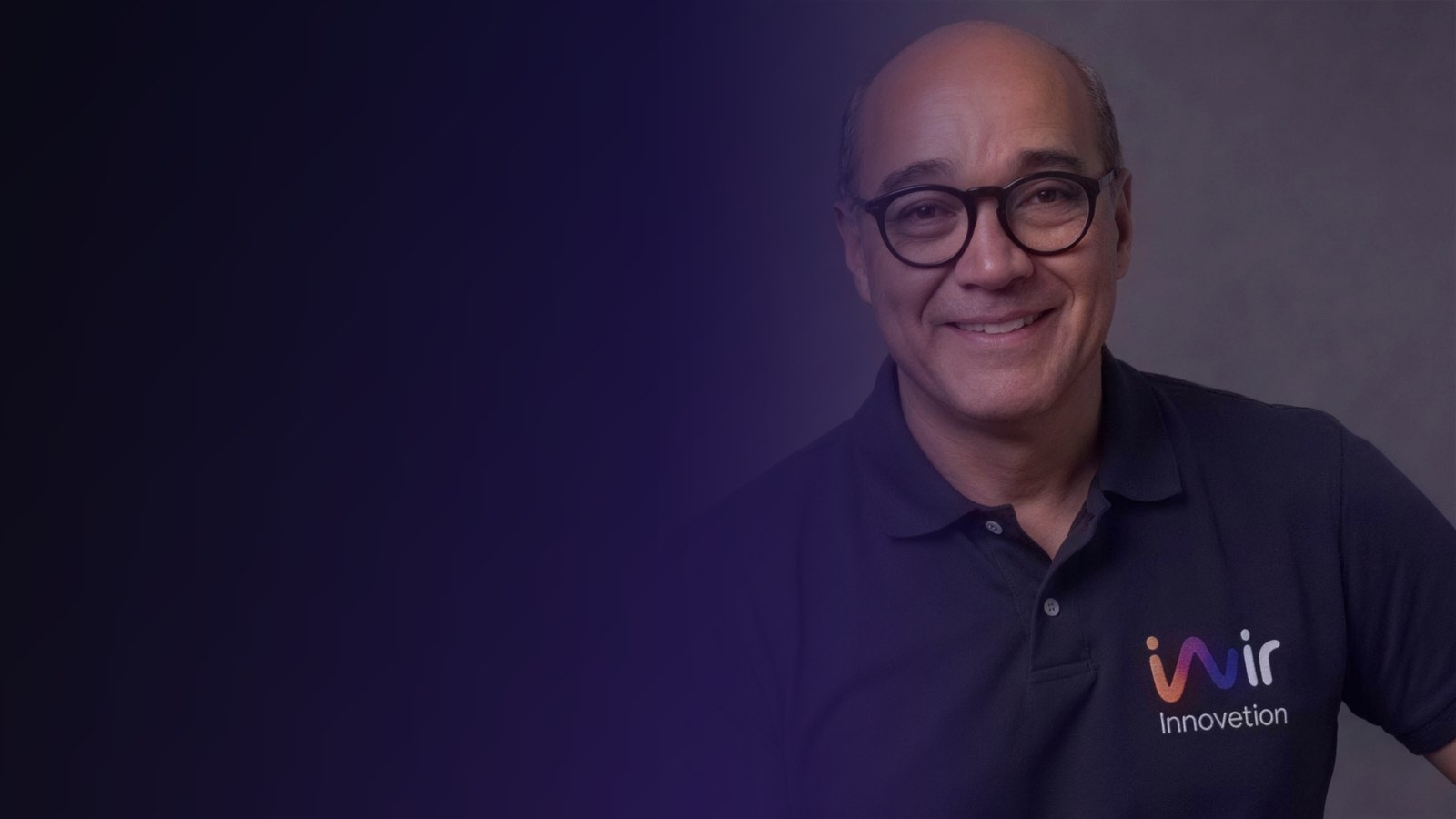
This conversation was recorded for the WIR Innovation Podcast and has been edited for reading. The answers are from José Carlos de Paula, CSO and co-founder of WIR Innovation.
Who is José Carlos de Paula
I am a civil engineer by training. Then came economics, an MBA in business, and a stretch at Cambridge studying business English. Along the way I kept adding courses in leadership, development and technology, because standing still on what I already knew never interested me.
My mother separated from my father very early and raised four children on her own. All four graduated and built careers. That explains a good part of how I think about work.
The career itself follows a logic I chose deliberately. Cycles of five to ten years per company. Banking, insurance, healthcare. Always moving into a new area once the previous cycle had given me what it had to give.
I started in banking because I needed the money
I was already working when I graduated, but those were jobs to pay for my studies. I went through several trainee processes and passed a few. Two were banks, and I picked banking for the simplest reason in the world: it paid better and I needed it.
I spent two years in the trainee program and then moved fast. At 24 I was already a branch manager. At 28, living in Rio, I was the only person from that market nominated for a program the bank called Future Directors. Thirty of us from all over Brazil, in São Paulo, with eighteen months to design new products and new revenue lines.
At the end of the program each of us took over a directorship. Mine was insurance.
Insurance found me at 29
I became the director responsible for every kind of cover sold to the bank's customers: life, private pension, home, commercial, auto. It was not my choice, it was where I landed. And it defined the next 25 years.
I stayed another four or five years. The bank ended up being sold, the market was hot, and I had offers from three other banks. I understood my cycle had closed.
The decade spent rebuilding a bank
I moved to Sudameris, a French-Italian bank, where I spent five years. I came in through the commercial and branch expansion side. In the last two years they moved me back to insurance, and there I built a joint venture with Generali, one of the bank's Italian shareholders.
That was when Santander arrived in Brazil buying banks. A headhunter called. They were going to acquire Banespa, the largest state-owned bank being privatised at the time. I took it.
I spent ten years at Santander and went through almost everything. The bank had bought five banks, including one larger than itself, and had to rebuild from the ground up. A new identity, and every legacy system had to collapse into one. Five banks had to become one.
I was commercial director, then product director, then back to insurance. When the bank decided to sell 51% of its non-core products and keep 49% in a joint venture, I was assigned to run the deal. We sold to Zurich and I stayed on as CEO of the brokerage.
Eight years in healthcare, the market I had never managed to touch
I served out the non-compete, sat on a few boards, and in 2014 Bain Capital came to Brazil to invest in healthcare. Roughly US$ 1.5 billion to acquire, consolidate, go public and then exit to a strategic buyer. That became Grupo NotreDame Intermédica.
Healthcare was the one piece missing from my career. At the bank we had managed to launch dental, but never health. Too complex, too particular, too much friction with the customer. The bank always avoided it.
It was extraordinary for exactly that reason. It was a different world and I had to learn it from scratch.
The project lasted exactly eight years: acquisitions, IPO, follow-on and the strategic merger at the end. There were twelve of us in the executive team. When the fund decided to exit, it released everyone from their contracts, because it was keeping only 5% and a board seat.
The new controlling shareholders asked me to stay another year or two to implement the synergy plan I had helped design during the year we spent waiting on CADE and ANS approvals. I did not want to go back to the old arrangement. I stopped being a shareholder, stopped being a statutory officer, and moved to a service provider contract so I would not carry the risk. I stayed another eighteen months and left.
After that I spent a year and a half at Athena Saúde, the healthcare holding backed by Pátria Investimentos. Of the three mandates they gave me, I executed two in under a year: consolidating six acquisitions into a single structure and rebuilding the marketing positioning, which was fragmented across different brand names. The third was expansion. The fund decided not to invest because interest rates had climbed. With no new project, there was no reason for me to stay. I resigned, ran the transition and left in 2025.
Today I invest and I sit on boards. I am an angel investor in a traveltech company that works as a marketplace of local guides and already operates in more than 110 countries. I sit on the board of a technology company serving the sales front end in healthcare, and on the board of a health discount-card operator, outside ANS regulation, with more than 1.1 million members and telemedicine across the base. I also set up a healthcare consultancy with a partner, where I stay purely on the strategy side.
Five things that define me
Relationships. I can build bridges with people, and that opened practically every door in my career.
The second is governance. I spent my whole life in multinationals and banks, environments obsessed with it, and I came out with a clear ruler for what is right and what is not.
I like learning. I do not accept things as delivered. I question in order to understand, because whoever accepts without questioning learns less.
Influence, but through giving. I can influence decisions without ever expecting something back. I give time and experience. It works at work and it works at home. I have three daughters, all married, and I created what I call the brotherhood of sons-in-law. I stay close to them, help where I can, and they give me back the oxygen I need to stay current.
And I am pragmatic about execution. If I believe in it, I go all the way. If I find out halfway that it was not what I thought, I know how to flip the switch and stop.
If I had to pick only one, I pick relationships. It is the one holding up the other four.
The people who shaped me
My mother, first. She is well into her years and still teaching me.
My wife, whom I met when I was 13. She was the counterweight in my life. When I pulled too hard in one direction, she balanced the other. There were times she stepped back to give me room and times she stepped in to hold me steady.
Outside the family, I had two real mentors. The first was Odilon Paulo Martins, early in my career. He found abilities in me that I could not yet see and put me in the right place. Sometimes we insist on doing something we are not prepared for, for lack of fit or of skill, and we do not notice. He noticed. We worked together for a few years and stayed friends for many more.
The second was Nilo Carvalho. He was my peer at the bank, very focused and very pragmatic. Years later, by coincidence, he ended up being my boss on the Bain Capital project. He was not the one who hired me, but I was glad to find him there. He is still a friend.
As a distant reference, Steve Jobs. Not because I agree with everything, because he did things that were not good. But he was disruptive in a way that moved the ruler. Without him, done his way, Apple would not be what it is.
Outside work
Three things fill my week. Family, always. I bring everyone I can into the house, because whoever is well at home has a shot at being well everywhere else.
Looking after my body is the second. I played tennis, football and basketball. I play less now because of a shoulder problem, but walking and running go into the week at least three times. There were stretches when I could not keep that up, because the corporate world is brutal with your time. Now I keep it.
And the third is having a project. I cannot live without one. Whoever has no project ends up with an empty life, at least in my case. Some people are satisfied with one. I need more, and I say it openly. Without it, I am not well.
Why leave the corporate world and build from zero
I was a multinational executive 90% of my life. And I always wanted to build something from zero. Not from zero by putting money in, I already did that as an investor. From zero by running it.
I have known Nicholas for a long time. When I left the bank I joined the board of the brokerage he had built with three other partners. He needed mentoring and structure. I helped create governance and clear lines of responsibility, and we went out to meet practically every insurance CEO in the market at the time to build credibility. We became friends and never lost touch, even as our paths diverged. We ended up acting as each other's advisors.
Last year the stars lined up. He was leaving a project, I was winding down mine, and we had always wanted to do something together without ever having the window. He showed up with the idea of working on artificial intelligence.
That landed. I have always liked technology and I wanted to go deep on AI, but in the corporate world your time is not yours. It belongs to the company. You give it 24 hours a day. I could find gaps, never depth.
I talked to Felipe, whom I already knew, and to Amanda, whom I knew of but had not met. He had just come back from a trip to see the Mahway project. I said yes.
We started WIR in October or November of last year, before Avante's holding company was even incorporated. And before everything that is happening today was happening.
What is different about this AI wave
In every project I was part of, I brought in whatever technology was available at the time. At Santander there was heavy investment in technology and I could simplify the sales process with what existed. But that was handing someone a tool to use.
Healthcare was different. The healthcare market is manual end to end, people writing by hand, and I gave myself permission to run a revolution: wipe it clean and digitise everything. There was no AI the way there is today.
The difference with AI is that it does not come to do more of the same. It comes to take away everything replicable and give back what only a human does, which is decide. The underwriter who prices and accepts risk gets to do the actual job instead of the manual work he does today. And you can get there in layers, through APIs, without touching the core.
I watched all of it happen. I worked without internet, used a fax and a typewriter. Then came the internet, social networks, 5G, the cloud. Each of those changed something. AI arrives adding all of it together, at a speed and a scope with no clear ceiling.
That is why I think my generation, if it knows how to use this, comes out ahead of whoever did not live through the earlier waves.
AI is not a wave you watch from the sand, waiting to see when to paddle out. Either you ride the whole thing or you do not ride it.
A lot of people are getting in only because everyone else is getting in. That does not work. If the leader does not understand that AI has to sit inside his own decisions, inside his team and inside the company culture, he will keep pushing projects, spending money and seeing no return. AI has to take root in the person before it becomes a system.
At WIR that became obvious when we went out to validate the products. We ran more than 20 meetings to test what we were building. What we think is one thing. What the customer feels on the other side is another. I had felt that pain, so I knew. But I needed him to confirm it.
The legacy I want to leave
Insurance is one wave ahead of healthcare in Brazil, and banking is one wave ahead of both. I caught the digitisation of the banks head on, and that was timing luck as much as anything else. Brazilian banks are a global reference today. Insurance came later. Healthcare still has a lot to come.
What I want to leave behind is knowledge. In every visit, every meeting with someone from the market, I give something away unprompted. There is not one conversation where I do not hand back part of what I learned.
Plenty of people built careers and trained for things that may not exist much longer, and have not stopped to think about it. Helping those people shift their mindset is the work. It builds credibility and reputation, and then people come looking for you on their own.
I hired a lot of people over my career and mentored trainee cohorts at the bank and on the Bain project. Several of them hold leadership positions today. Every time I publish something about AI on LinkedIn, one of them shows up wanting to talk. That is already happening, and it is the part I enjoy most.
I changed my thinking. I could be sitting here reasoning the way I did in the past, and it would not work. If I could change, with the mileage I carry, almost anyone can.
Read next
Frequently asked questions
Who is José Carlos de Paula?
José Carlos de Paula is CSO and co-founder of WIR Innovation, an AI platform for the insurance market. A civil engineer by training, with degrees in economics and an MBA, he built a four-decade career across three sectors: banking, insurance and healthcare. He became an insurance director at 29, spent ten years at Santander, served as CEO of the bank's brokerage after its joint venture with Zurich, and then spent eight years as an executive at Grupo NotreDame Intermédica, Bain Capital's Brazilian healthcare platform.
What is José Carlos de Paula's experience in insurance?
He entered insurance at 29 as the director responsible for life, private pension, home, commercial and auto cover in a Brazilian bank's bancassurance operation. He later built an insurance joint venture with Generali at Sudameris, and at Santander he led the sale of 51% of the bank's non-core products to Zurich, then took over as CEO of the bank's brokerage.
What did José Carlos de Paula do in healthcare?
In 2014 he joined Bain Capital's healthcare project in Brazil, which became Grupo NotreDame Intermédica: an investment of roughly US$ 1.5 billion to acquire, consolidate, go public and exit to a strategic buyer. He stayed eight years, through acquisitions, IPO, follow-on and the final merger. He then spent a year and a half leading the consolidation of Athena Saúde, a Pátria Investimentos healthcare holding.
Why did José Carlos de Paula co-found WIR Innovation?
He had known Nicholas Weiser for years, since sitting on the board of the brokerage Nicholas had built. In 2025 both were exiting projects at the same time and decided to build something together in artificial intelligence applied to insurance. WIR started operating before Avante's holding company was even formally incorporated.